The Shapes of Our Planning Processes
While in college, I had a wise mentor offer her approach to planning any collaborative project. She called it ”The Sideways Diamond.”
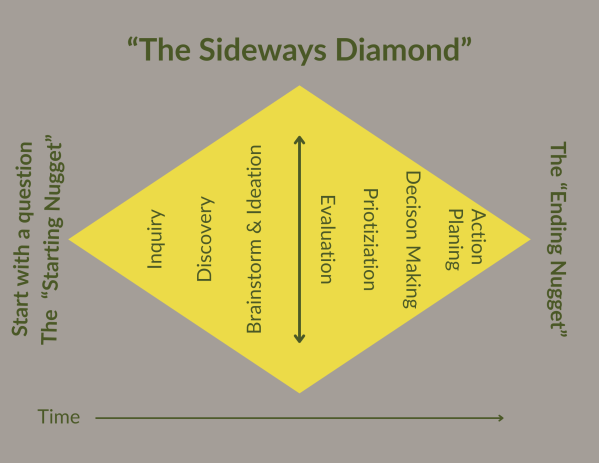
In “The Sideways Diamond”, you begin on the far left with a singular point of inquiry, or as I like to call it “The Starting Nugget”.
Then, as you inquire, you begin to expand your diamond – through bold brainstorming and ideation, exploring all the options and directions a project could take – until you max out at the highest and lowest points of your shape.
Then through evaluation, prioritization and thoughtful decision making processes, you narrow down the project back in to a final, singular point (or “nugget”) on the far right. It’s the end of your project, where you’ve made your final decisions, you’ve right fitted your solutions and are ready for action.
“The Sideways Diamond “has been my go to analogy for planning processes for years. It seems to work well for me and my collaborators.
That is, until one time, it didn’t.
I was working with a creative/artist collaborator – which I love doing – but just felt like we were stuck in expansion mode, extending those top and bottom points beyond what I could hold.
Every effort I made to get them back towards that singular point just seemed to bounce back at me. I tried and tried and tried to get them back in to my perfect “The Sideways Diamond,” and, well, I just couldn’t!
Feeling frustrated, I spoke with a friend who also knew this creative, and she wisely said to me, “There’s a reason this isn’t working. It’s because this person never started with a single point. For them, there were always multiple points, big and bold and intermingled and multi-modal points. I’m sorry, but they’re just never going to fit into your ‘Sideways Diamond.’ Maybe instead of continuing to try to force them into your shape, you should ask them to tell you more about their plannings shape?”
RIGHT! OF COURSE! My shape isn’t the only shape. It’s certainly not everyone’s shape!
In fact, all our shapes are probably different, because we are all different and our brains process information and ideas in so many different ways. (ps: I find this to be especially true for creatives/artists which is why I love working with them!!)
Having learned from this challenging experience, the next time I launched a project with creatives/artists, I took my friend’s advice, and one of the activities we did during our first session together was each draw “The Shape of our Planning Processes.”
With shiny Jelly Roll pens, blank sheets of printer paper, and just 5 minutes, we started drawing, to later describe our processes to each other.
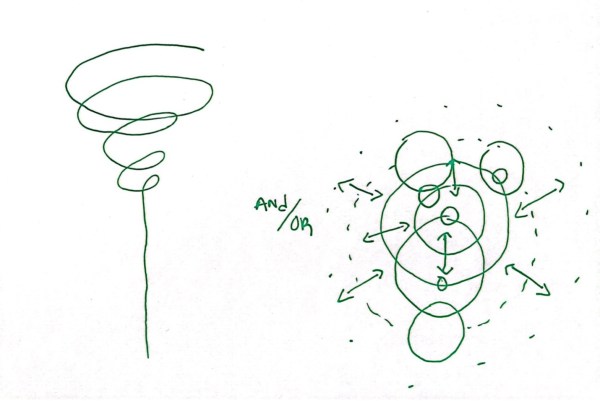
One described their process as “Circling around until we drop into the center” and/or “Outward, overlapping, reverberation in an orbiting ecosystem.”
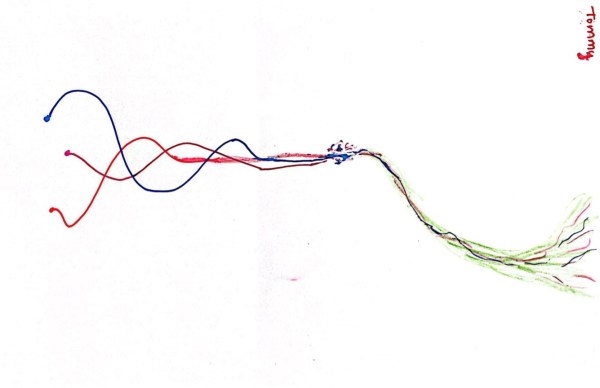
Another described their “intersecting paths leading into a metamorphosis with a unified path but with threads of what we each brought.”
And another, “An entry point moving in to element floating with connections, with one clear direction yet with many branches.”
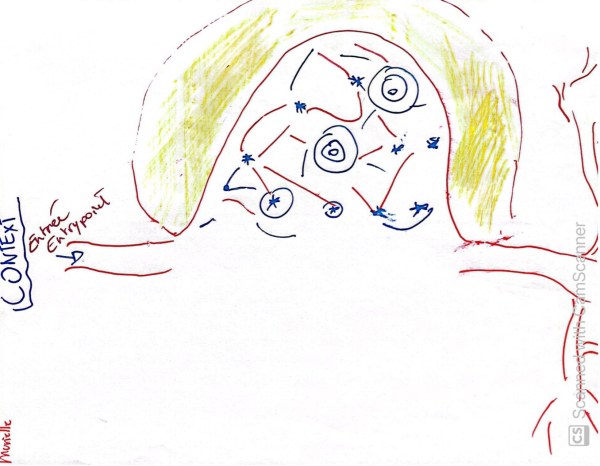
First off, this is why working with creatives/artists is the best! This language is expansive, provoking, complex, and emergent.
AND ALSO, learning about my client/collaborators approach to starting our planning process together has offered such clarity in how they will move through the work we do together, and how I can best design processes that support them.
I encourage you to try drawing the shape of your approach to a planning process! Or better yet, the next time you launch a new project, ask your collaborators to each draw theirs too. I’m certain it will lead to valuable and supportive learning for your work together.
Special thanks to the incredible artist/practitioners at Culture Mill – Murielle Elizéon, Tommy Noonan, and Caitlyn Swett -for their permission to share their “shapes” for this blog post.
 Hilary Pollan Facilitation