Creating Work Plans to Promote Equity
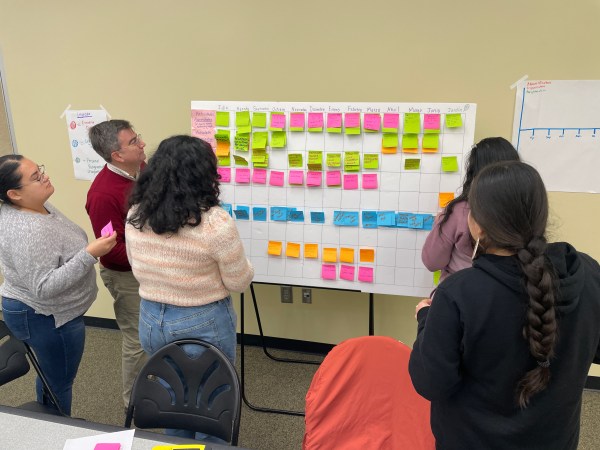
Earlier this month El Vínculo/Hispanic Liaison invited me to facilitate their annual staff retreat. Using a participatory and visual facilitation approach, we collaboratively developed a process for creating annual program work plans. It was a fabulous day of creative ideas sharing, improv games, and consensus decision-making!
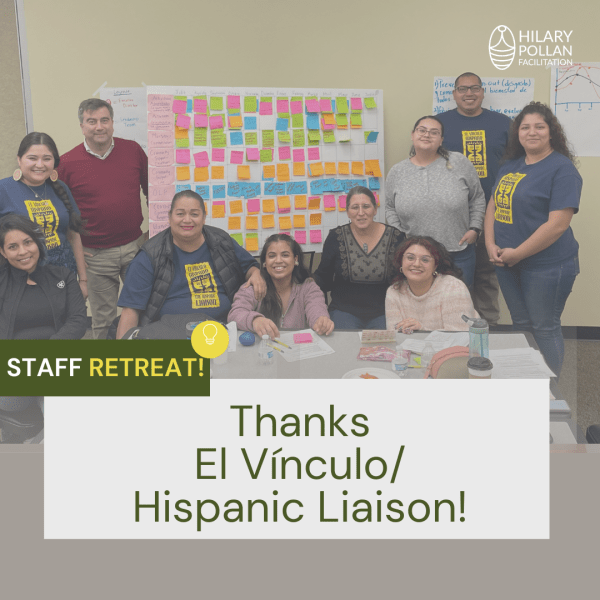
This retreat also got me thinking deeply about how creating annual work plans can be an effective tool at promoting equity within your organization.
What are work plans?
When we’re deep in the work grind (which it feels like most of us are!), work plans are an annual invitation to come up for air to engage in future-oriented and systems-level conversations.
This retreat also got me thinking deeply about how creating annual work plans can be an effective tool at promoting equity within your organization.
Work Plans can take many forms. But I like to think of them as a document co-created annually that includes the information everyone involved needs to know and/or discuss to prepare for a successful year ahead.
For example, a work plan may include:
- Goals and Objectives (or Outcomes and Outputs)
- Anticipated timeline of activities
- Resources needed
- Ideas for the future (I like to call this the “Garden” where seeds are planted!)
While these are some common items in work plans, a work plan can include whatever topics feel important for your organization/program/team to check-in on and discuss on an annual basis. Be creative! Think about the conversations you want to be having, the information you all need and want to know to do your best work, the systems for accountability and evaluation you want have in place, etc.
How do work plans promote equity?
I like to think of work plans as an opportunity for a two-way conversation. Work plans allows managers and front-line staff (or supervisors and supervisees) to check-in at least once a year about expectations, interests, and ideas. During these conversations, they can co-determine their program or team’s work for the year ahead.
Conversations around work plans are especially valuable and important invitations for front-line staff/supervisees to share their observations around opportunities for efficiencies and innovations that may not be obvious at the leadership level AND to express their ideas, dreams and/or aspirations for their role and work. Again, when we’re in the grind, we often forget to discuss everyone’s ideas!
When work plans are used as an opportunity for conversation, we become oriented toward possibility and accountability, rather than punitive or prescriptive responses. It invites us to explore and be in conversation about valuable questions like:
- Why is something working and/or not working?
- What do want to change and/or do differently moving forward?
- What challenges do we anticipate and/or boundaries do we want to set?
- How can we support each other in achieving this and/or making these changes?
Such conversations humanize our work and builds stronger, trust-based relationships between supervisors and supervisees. As adrienne maree brown says, “trust the people and they will be trust worthy.”
Work plans also promote a systems-level view of an organization. Work plans can cumulatively capture a full picture of all the activities going in the next year. This full-picture allows organization/teams to think about how all the pieces discussed in the work plans fit together, and how to best allocate resources accordingly.
Relatedly, work plans can help prevent burnout and promote well-being in the organization. If an organization/team looks at the full-picture of their work, it can help them determine if they are setting realistic expectations for the whole organization and individual team members, or if things maybe need to be scaled back. Again, this is especially important for supervisees/front-line staff to be able to express how they’re managing workload in light of decisions and/or changing contexts.
How to use equity-oriented work plans in your workplace:
Here are some ideas for how to get started in using work plans in your organization which encourage constructive dialogue and promote systems-level thinking that encourages collaboration and wellbeing.
- Work collaboratively with your team/staff to create a work plan template that fits their interests and needs, and that will encourage two-way and systems-level conversation (Hilary can help with this!)
- Identify a group of people – a combination of BOTH supervisors and supervisees – to help implement the annual work plan process across the organization.
- Treat the work plan as a tool for accountability and setting shared expectations, grounded in actionable support.
- Be open to learning with and from others in creating these work plans. Supervisors – listen to the observations of your supervisees. Supervisees – be courageous in sharing your ideas.
- Practice trust, active listening, and getting to know each other through this work plan creation process.
How are you using work plans in your workplace? What values and types of thinking do they promote? Share your ideas in the comments!
 Hilary Pollan Facilitation